What You'll Learn
- Trace the major eras of AI history, from the 1940s to today
- Name the key milestones and the people behind them
- Explain what the "AI winters" were — and why they happened
- List the disciplines that contributed ideas and tools to AI
Prerequisites: Module 1 — What is AI? You should already know the four definitions of AI and the Turing Test.
The Story of AI: A Timeline
AI's history is not a straight line of progress. It is a story of bold ideas, spectacular hype, painful crashes, and hard-won comebacks — a cycle that has repeated more than once. Here is the whole arc at a glance:
Gestation of AI (1943–1955)
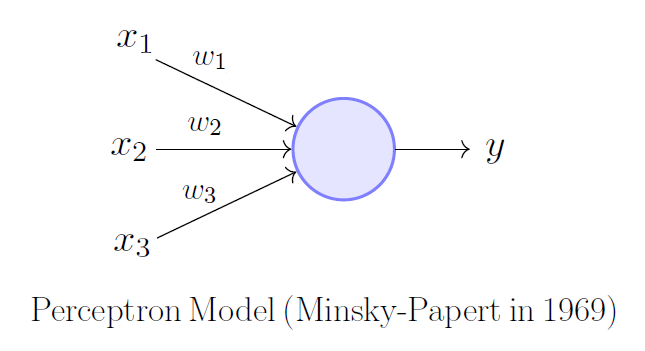
AI began before it had a name. In 1943, Warren McCulloch and Walter Pitts proposed a binary model of artificial neurons — simple on/off units wired together — and showed that any computable function can be modeled by a network of neurons. In 1950, Alan Turing published "Computing Machinery and Intelligence", introducing the Turing Test and, remarkably, anticipating both machine learning and reinforcement learning decades before they existed. Frank Rosenblatt then built the perceptron, an early learning neural network that could adjust its own connection weights.
The Birth of AI (1956)
In the summer of 1956, a small group of researchers gathered at the Dartmouth workshop in New Hampshire — and the field officially got its name: Artificial Intelligence. Around the same time, the Logic Theorist program demonstrated something astonishing for its day: a computer proving mathematical theorems.
Early Enthusiasm, Great Expectations (1952–1969)
Success followed success. The General Problem Solver imitated the step-by-step way humans solve puzzles. LISP was defined and became the programming language of AI for decades. In 1965, Robinson's resolution method gave machines a complete, general procedure for logical reasoning. Researchers boldly predicted human-level AI within a generation.
The First AI Winter (1966–1973)
Then reality hit. Many AI problems turned out to be computationally intractable — methods that worked on toy examples exploded combinatorially on real ones. Neural network research faded after Minsky & Papert's critique exposed fundamental limits of single-layer perceptrons. Funding dried up, and AI entered its first winter.
Knowledge-Based Systems (1969–1979)
The field recovered by changing strategy: instead of general-purpose reasoning, feed the machine domain-specific expert knowledge. This powered the first expert systems — DENDRAL (inferring molecular structure) and MYCIN (diagnosing blood infections) — which reasoned impressively well inside their narrow domains.
AI Becomes an Industry (1980–now)
Expert systems went commercial. Digital Equipment Corporation's R1 configured computer orders and helped grow the AI industry from a few million to billions of dollars in just 8 years. But the boom overheated: when the expert-system bubble burst, the second AI winter (1987–1991) followed — systems proved brittle, expensive to maintain, and unable to learn.
The Return of Neural Networks (1986–now)
Meanwhile, neural networks quietly came back from the dead. The back-propagation algorithm made it practical to train multi-layer networks — exactly the limitation Minsky & Papert had pointed to — reigniting the connectionist approach.
Intelligent Agents (1995–now)
With the rise of the internet, AI reframed itself around the concept of the intelligent agent — a system that perceives its environment and acts on it. AI moved into everyday products: search engines and recommender systems became AI's quiet, ubiquitous successes.
Big Data (2001–now) & the Deep Learning Revolution (2010–now)
Two ingredients changed everything: large datasets from the web and GPUs that made massive neural networks trainable. The ImageNet breakthrough (2012) showed deep networks crushing prior records in vision; AlphaGo (2016) defeated a world champion at Go; and large language models brought AI into hundreds of millions of daily conversations. The perceptron's descendants now run the show.
| Era | Years | Key milestones |
|---|---|---|
| Gestation of AI | 1943–1955 | McCulloch & Pitts artificial neuron (1943); Turing's "Computing Machinery and Intelligence" (1950); Rosenblatt's perceptron |
| Birth of AI | 1956 | Dartmouth workshop names the field; Logic Theorist proves theorems |
| Early enthusiasm | 1952–1969 | General Problem Solver; LISP; Robinson's resolution method (1965) |
| First AI winter | 1966–1973 | Combinatorial intractability; Minsky & Papert's perceptron critique; funding cuts |
| Knowledge-based systems | 1969–1979 | Expert knowledge beats general methods: DENDRAL, MYCIN |
| AI as an industry | 1980–now | DEC's R1 expert system; boom to billions in 8 years; second AI winter (1987–1991) |
| Return of neural networks | 1986–now | Back-propagation enables multi-layer network training |
| Intelligent agents | 1995–now | Search engines, recommender systems |
| Big data & deep learning | 2001–now / 2010–now | Large datasets + GPUs; ImageNet, AlphaGo, large language models |
What causes an AI winter?
Both winters followed the same recipe: inflated promises ("human-level AI in 20 years"), then a collision with combinatorial explosion — methods that worked on small demos failed utterly at real-world scale — followed by funding cuts when sponsors lost patience. The lesson stuck: AI progress is real, but hype is its oldest enemy.
The Foundations: Disciplines Behind AI
AI did not appear out of thin air. It inherited its questions, tools, and vocabulary from disciplines that had been thinking about minds, machines, and reasoning for centuries. Each one answered a different piece of the puzzle:
| Discipline | Contribution to AI |
|---|---|
| Philosophy | Logic, methods of reasoning, and the very concept of rationality — can formal rules yield valid conclusions? |
| Mathematics | Formal representation and proof, algorithms, computation, (un)decidability, (in)tractability, and probability. |
| Economics | Utility and decision theory — how to decide rationally under uncertainty to maximize expected payoff. |
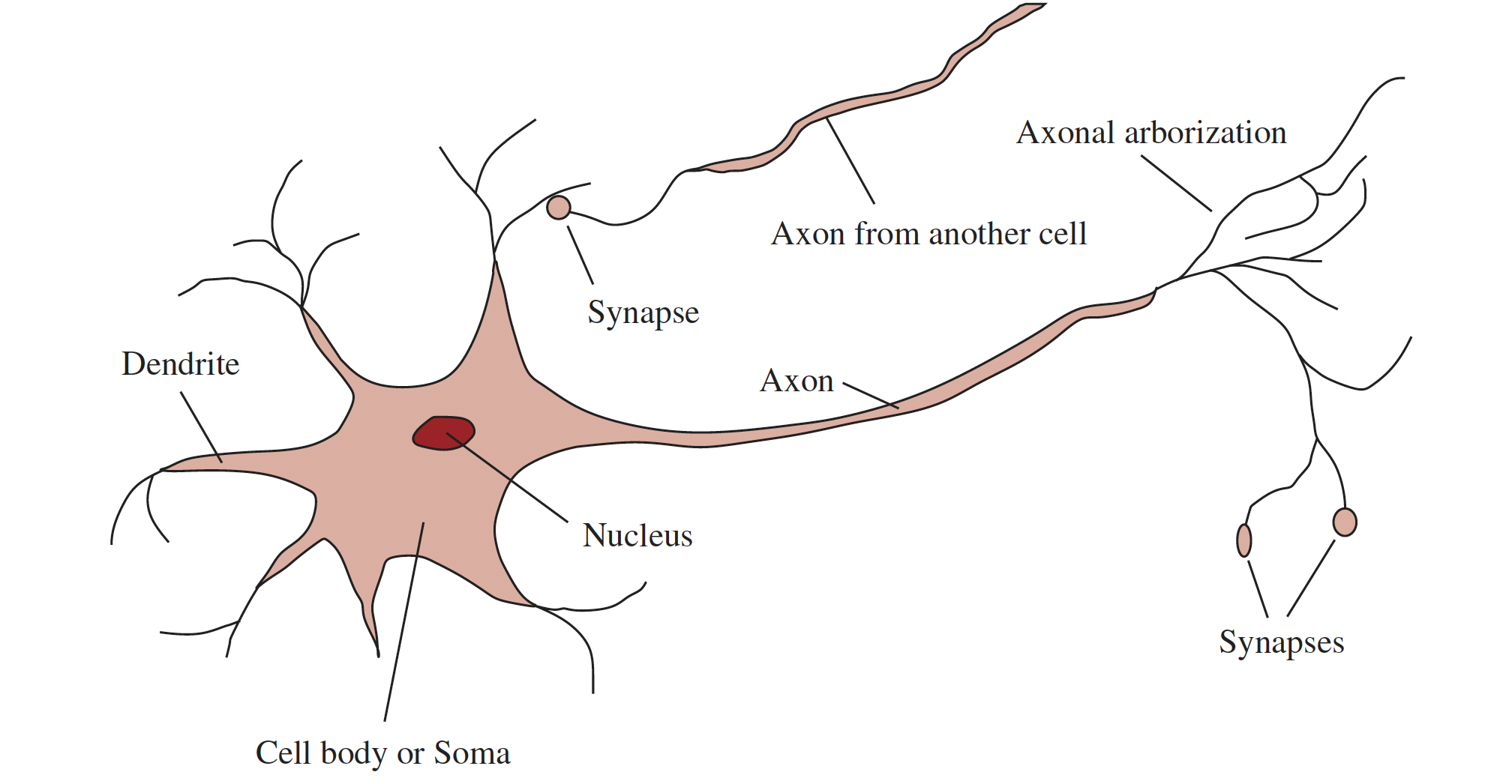
| Neuroscience | Neurons as information-processing units — the biological inspiration behind neural networks. |
| Psychology / Cognitive Science | How people behave, perceive, process information, and represent knowledge. |
| Computer Engineering | Building ever-faster computers — the hardware that makes AI feasible at all. |
| Control Theory | Designing systems that act to maximize an objective function over time. |
| Linguistics | Knowledge representation and grammar — how language structures meaning. |
AI is deeply interdisciplinary
Notice how every era of the timeline drew on a different foundation: the perceptron came from neuroscience, resolution from philosophy and mathematics, decision-making agents from economics and control theory. AI is where all of these disciplines meet — and that is exactly why it is so hard, and so interesting.
Where This Course Goes
Now that you have the historical map, here is where we're headed. The next module introduces intelligent agents — the framework modern AI is organized around. Then we dive into problem solving & search (Modules 4–6): uninformed search, heuristic search, and the famous A* algorithm.
Later topics build upward from there: knowledge representation, logic and inference, expert systems, and machine learning — coming soon on the course page.
Why start with search?
History points the way: search was one of AI's first great successes — the Logic Theorist and the General Problem Solver were, at their core, search programs. Sixty years later, search is still the foundation: route planners, game-playing engines, and even parts of modern planning systems are built on the ideas you'll learn in Modules 4–6.
Exercise
Three quick checks — try each one before opening the solution. If you can answer these from memory, the timeline has stuck.
Put history in order
Order these five events chronologically, earliest first: the return of back-propagation · the Dartmouth workshop · the McCulloch-Pitts neuron · the deep learning revolution · the R1 expert system.
Solution
- 1943 — McCulloch-Pitts artificial neuron
- 1956 — Dartmouth workshop (AI gets its name)
- 1980 — R1 expert system at Digital Equipment Corporation
- 1986 — return of neural networks via back-propagation
- 2010 — the deep learning revolution begins
Two winters, two causes
Both AI winters involved hype and funding cuts — but the trigger was different each time. Explain what specifically caused the first winter (1966–1973) versus the second (1987–1991).
Solution
First winter (1966–1973): a crisis of capability. General-purpose methods that worked on toy problems turned out to be computationally intractable at real scale (combinatorial explosion), and Minsky & Papert's critique of perceptrons killed off neural network research and its funding.
Second winter (1987–1991): a crisis of commerce. The expert-system industry had boomed to billions of dollars, but the systems proved brittle, costly to maintain, and unable to learn — the commercial bubble burst and investment collapsed.
Match the discipline
Match each discipline to its contribution: Economics, Neuroscience, Control Theory, Linguistics — versus — (a) neurons as information-processing units, (b) knowledge representation and grammar, (c) utility and decision theory under uncertainty, (d) systems that maximize an objective function over time.
Solution
- Economics → (c) utility and decision theory — deciding under uncertainty
- Neuroscience → (a) neurons as information-processing units
- Control Theory → (d) systems that maximize an objective function over time
- Linguistics → (b) knowledge representation and grammar
Recap & What's Next
You now know
The full arc of AI history — gestation (McCulloch-Pitts, Turing), the 1956 Dartmouth birth, early enthusiasm (GPS, LISP, resolution), two AI winters and their causes, expert systems and the AI industry, back-propagation's comeback, intelligent agents, and the big-data/deep-learning era. And you can name the eight disciplines whose ideas AI is built on.
Next up: Module 3 — Intelligent Agents. We take the framing that ended the history — AI as the study of agents that perceive and act — and make it precise: agents, environments, rationality, and the PEAS framework.